⛆ Godland ⛆
Years ago I remember seeing a video, recorded very casually, of someone eating a spit-roasted mammal. People were commenting in horror & disgust at the person ripping cooked skin off with their bare hands to eat. But others were confused, 'what's wrong with this? -isn't this normal?' and yeah, what is the difference really? The large majority of people eat dead animals, but they did not grow up with the slaughter, they were separated in many ways from the source of food and the food itself. Food has become abstract for many of us (just like almost everything in our lives now). For people who grew up with this norm of direct contact with their food, there isn't anything disgusting or horrifying about the process. Now that many of us can live so separated from the source, we see from a distance and have the perspective of it being an abhorrent process. Of course, the mauling with your hands is the way of nature, and we who have been separate from nature and the constant of 'life feeding on life' are able to be shocked by birds of prey dropping rats on rocks, cats torturing half-dead mice, and snakes swallowing rabbits whole, still breathing. The horrors persist, but so do we, the herd of gazelle lower their stress response of cortisol and go back to their grazing as their elder is being eaten alive by leopard a few metres away.
Our contemporary separation from nature isn't the only thing that leads people to vegetarianism. Cultures such as Jainism have been eating only fallen apples for thousands of years, having had an anthropromorphic empathy switch flipped somewhere along the way (stopping myself from getting into the conscioussnes spectrum here). What I'm really interested in now is our accursed middle place between the natural and the spiritual world.
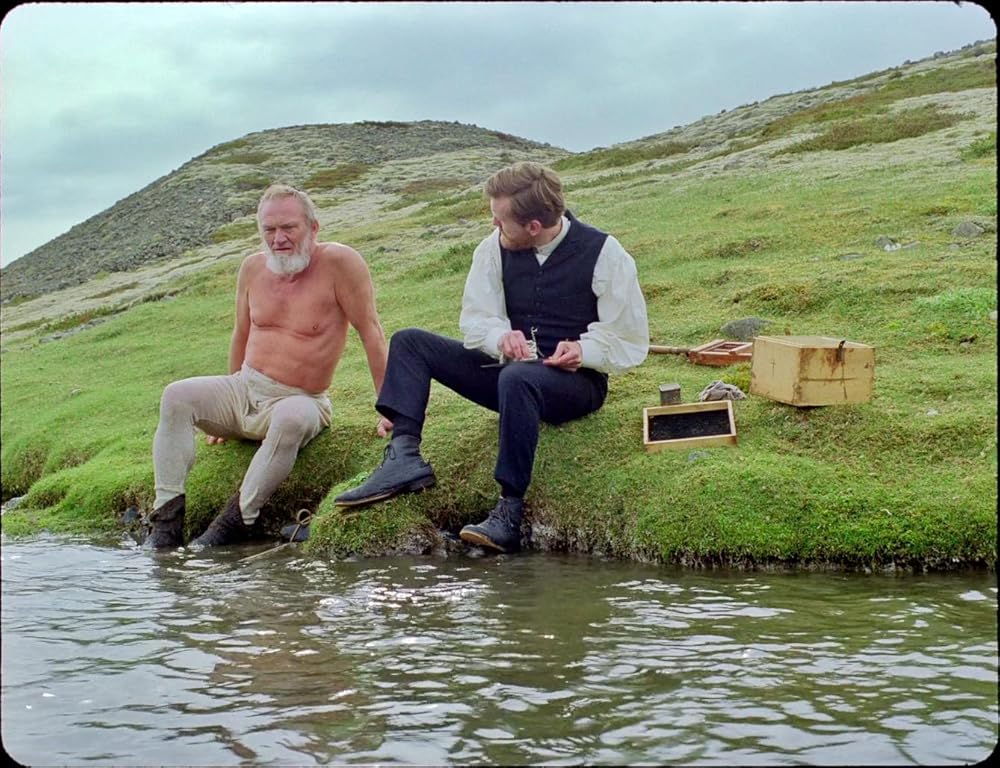
I've heard a more accurate translation of Godland's original Danish title is something more like 'God-forsaken land.' Our priest's guide into the alien wilds of Iceland is Ragnar, a man who seems entirely integrated with his environment. An early scene features the full killing, skinning, gutting, and cooking of a sheep. Later, he lays out a net (while our priest is fiddling with his strange mechanisms) and the next morning he has a basket piled full of fish-flesh. Then comes a crucial scene, during his morning exercises we see (through the gaze of the priest) a man so entirely connected to nature, that he is nature. We see his wet feet in the moss and his skin is so thin that there is no barrier. We cannot delude ourselves that he is some abstract, spritual being; he is an amalgamation of biology. His veins and organs pulse and writhe within, no different from a flailing fish on land. Here the priest's prejudice for otherness can become concrete (beyond his cultural/linguistic isolation-tension) unlike Ragnar, he is a divine being, he does not wriggle in the mud like a worm.
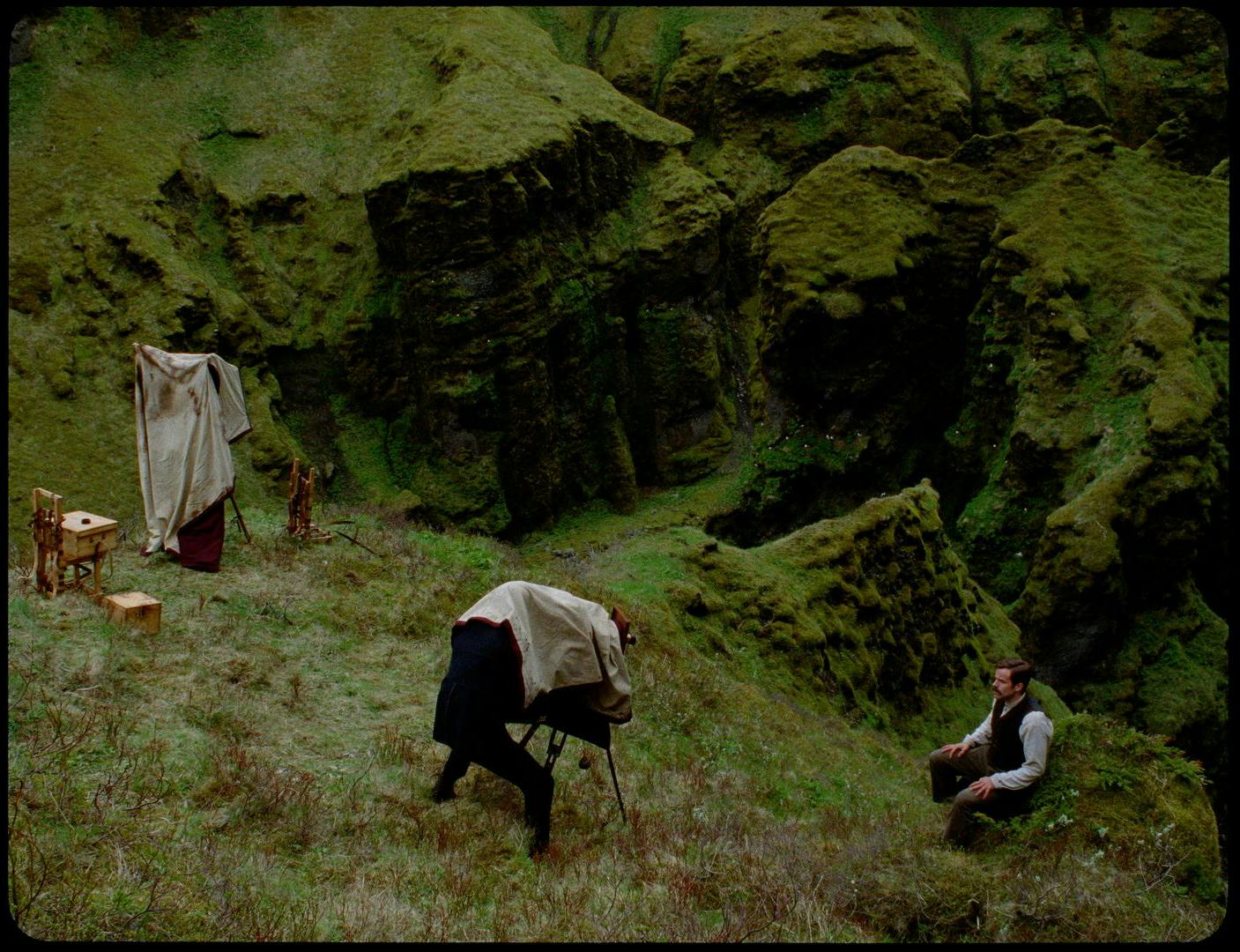
The priest and the interpreter go out on their little journey to the waterfall with the excitement of colonizers on an alien planet. The geography of Iceland may appear very alien to us, with its volcanic geology, but it is indeed entirely natural, the way much of Earth was at one time. When they take their clothes off and scream at the waterfall, it feels much more like an attempt at reaching at some transcendant spiritual experience, rather than a deep integration with nature. Afterwards, the interpreter shaves the priest, as if to rid himself of the base, and the animalistic (unlike the bearded Ragnar). The creature that emerges from this grooming ritual is nearly unrecognizable, strange, and less human (in a rare break from the movie standard of feminine nudity intended as erotic and masculine nudity intended as comedy, the priest awakens in the basement like an otherworldly creature and creates an atmosphere of fear & angst with his nakedness).
I found myself while watching the earthly ways of Ragnar that they seemed entirely foreign to me in my domesticated life. Both in how they lived, their surroundings, and particularly the items they had with them. In that environment, you know who made your shoes, you knew the animal that the leather was taken from, you know the tree the wood in the heel was taken from. This compared to the thousands of people that had a hand in the shoes we wear today and the unapparent nature of what our shoes are made of and how they were made and where they came from. Fumbling around with a camera appears more natural to me even though it is like alien technology (though even the priest has a sense of nature in his time with using things like eggs to process the photography rather than a strange liquid of unknown origin & compisition). Even our names, once filled with meaning, are now mostly sounds intentionally meant to not mean anything - their origins forgotten. The stacking of so many different things that separate us from nature makes earth feel alien to us and our natural selves.
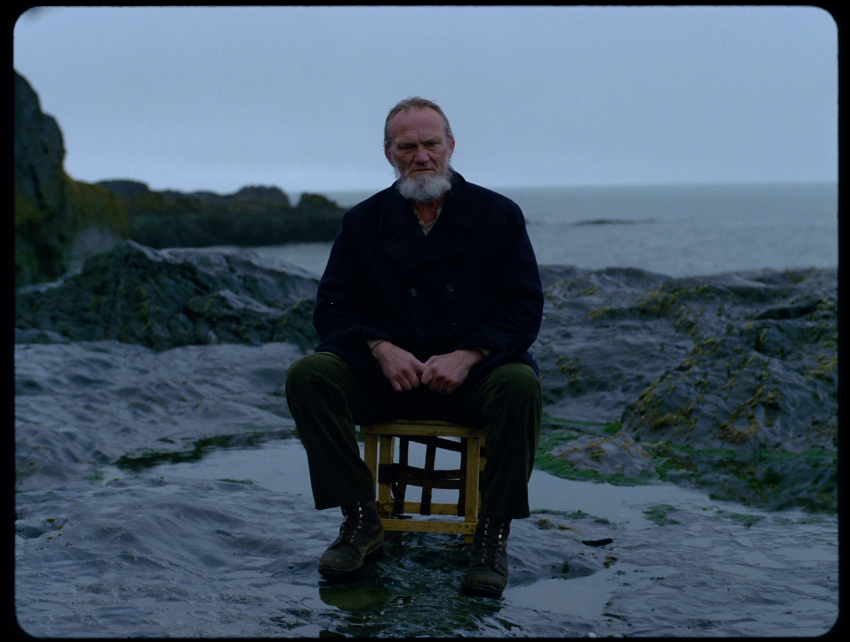
There is an inherent objectification in taking someone's picture, stealing themselves from them. There is the sociological aspect of fitting someone to your gaze in a moment of time yes, but there is a subtler thing lost when the power dynamic of camera operator and subject literalizes the everyday subject-object relationships that we often ignore. You are forced to be something that is 'seen' and not something that has agency. Even moreso when the control of the photo is not in your hands, as what leads to the final climax between the priest and Ragnar.
I initially assumed that Ragnar was an image of perfect contentment, but we learn that even he has been colonized (literally) by guilt. The first scene where he asks the priest how to be a man of god then the stunning 'pray for me' scene. In being given a glimpse of heaven, he becomes as Enkidu, and can no longer fully integrate with nature. That indeed we are all both beautiful and filled with excrement. Here, the priest may no longer be able to see Ragnar as an 'other.' No longer be able to separate himself from the Earth, may no longer be able to see himself as an abstracted divine being, may no longer be able to see himself as not an animal.
As the dog barks and the baby cries during the first church service, and the priest goes out only to slip and roll in the mud, I really feel the right response after months of perilous journeying and combined effort is to just leave town and never look back before you're able to do the thing you came there for. My friend recently told me a metaphor of a worm in the mud that upon hearing the rain, wriggles out of the dirt and onto the pavement where it dies. He told me that we are the worm that hears traces of transcendant divinity and strives to crawl out of the muck only to die on the pavement beyond our understanding, poured on by the rain from heaven or burnt in the sun. Perhaps we will get some kind of glimpse if we do, but maybe we should live as worms that listen to the rain, know it is there, yet still live in the mud.
I feel myself at the divergence of three roads within myself (false trichotomy?). A return to & embracing the body for self - the earth and being fully integrated into its ways. Turning deeper into the spiritual soul/no self/formless spectator - fully striving beyond this world. Or, an acceptance of this wishy washy mix where the mud poisons the heavens and the divine taints the earth - this human place between sea and sky. I do not want one thing, but I cannot tear myself apart and walk multiple paths?
Related: On Divine Purity